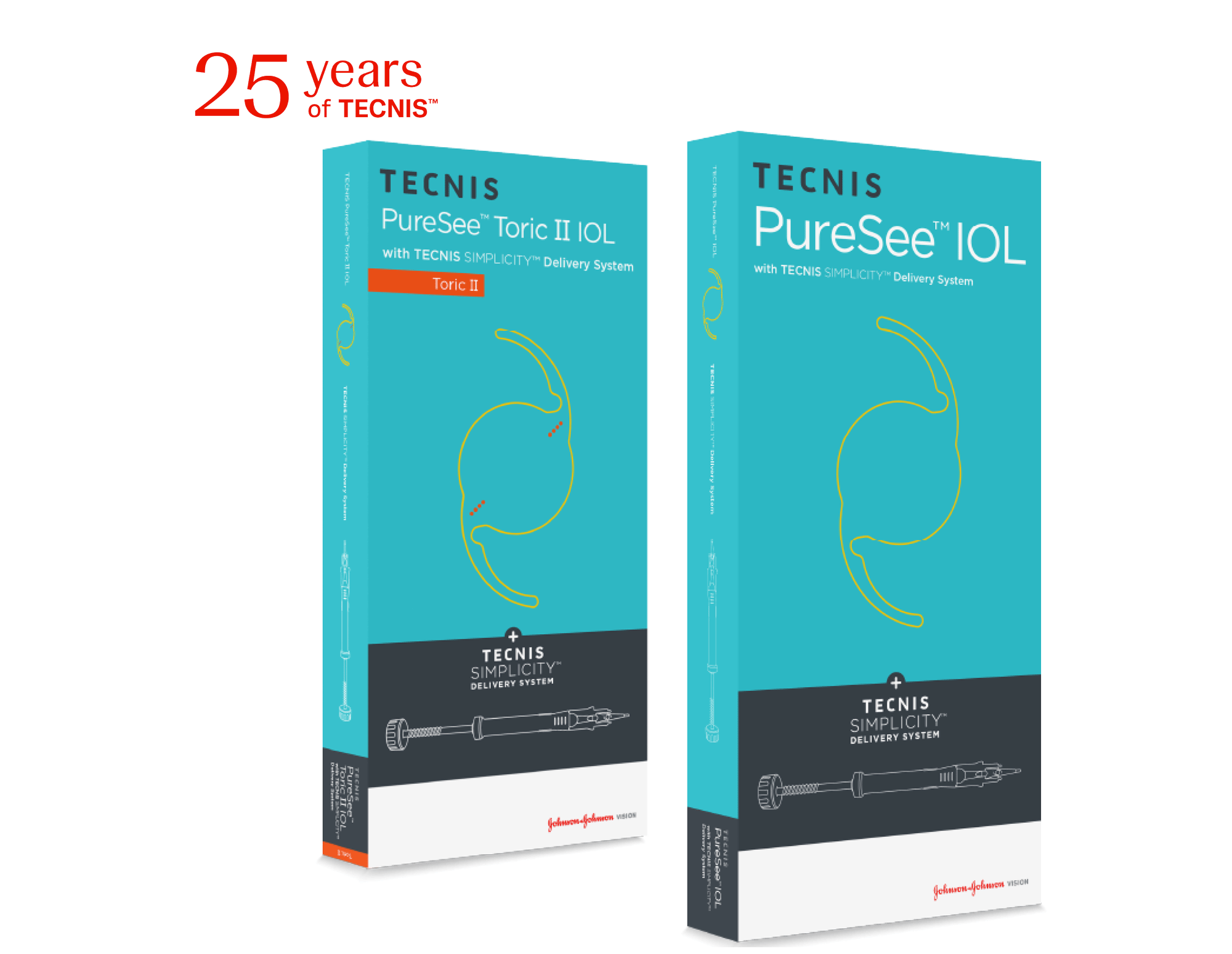
TECNIS PureSee IOL

TECNIS PureSee™ IOL with TECNIS SIMPLICITY™ Delivery System
The new purely refractive extended depth-of-focus IOL with monofocal-like dysphotopsia1
TECNIS PureSee™ IOL with TECNIS SIMPLICITY™ Delivery System
The new purely refractive extended depth-of-focus IOL with monofocal-like dysphotopsia1

Key Features

Monofocal-like Visual Disturbance Profile1

Excellent Contrast1

Range of Vision1

Tolerance to Refractive Error3

90%

Of patients occasionally or never wore glasses*1

97%

Of patients would recommend the lens to friends or relatives**2

97%

Of patients reported no very bothersome visual disturbances1

*Overall spectacle wear at 6 months, none/a little/some of the time

**Prospective, randomized, multi-center 6-month clinical study. N=66
Excellent distance and intermediate vision with some near*1

TECNIS PureSee delivers monofocal-like distance visual acuity1
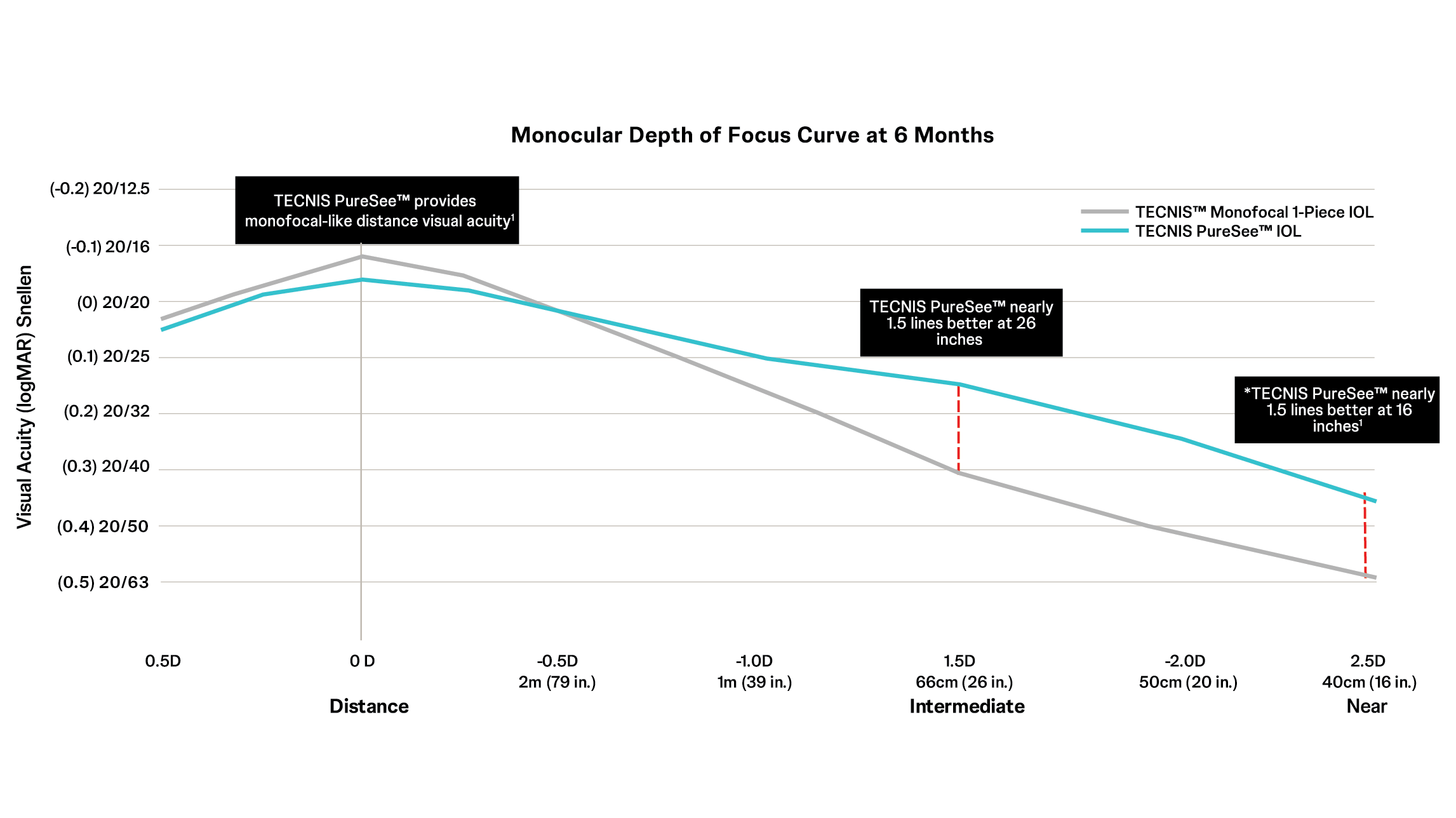
Monofocal-like distance visual

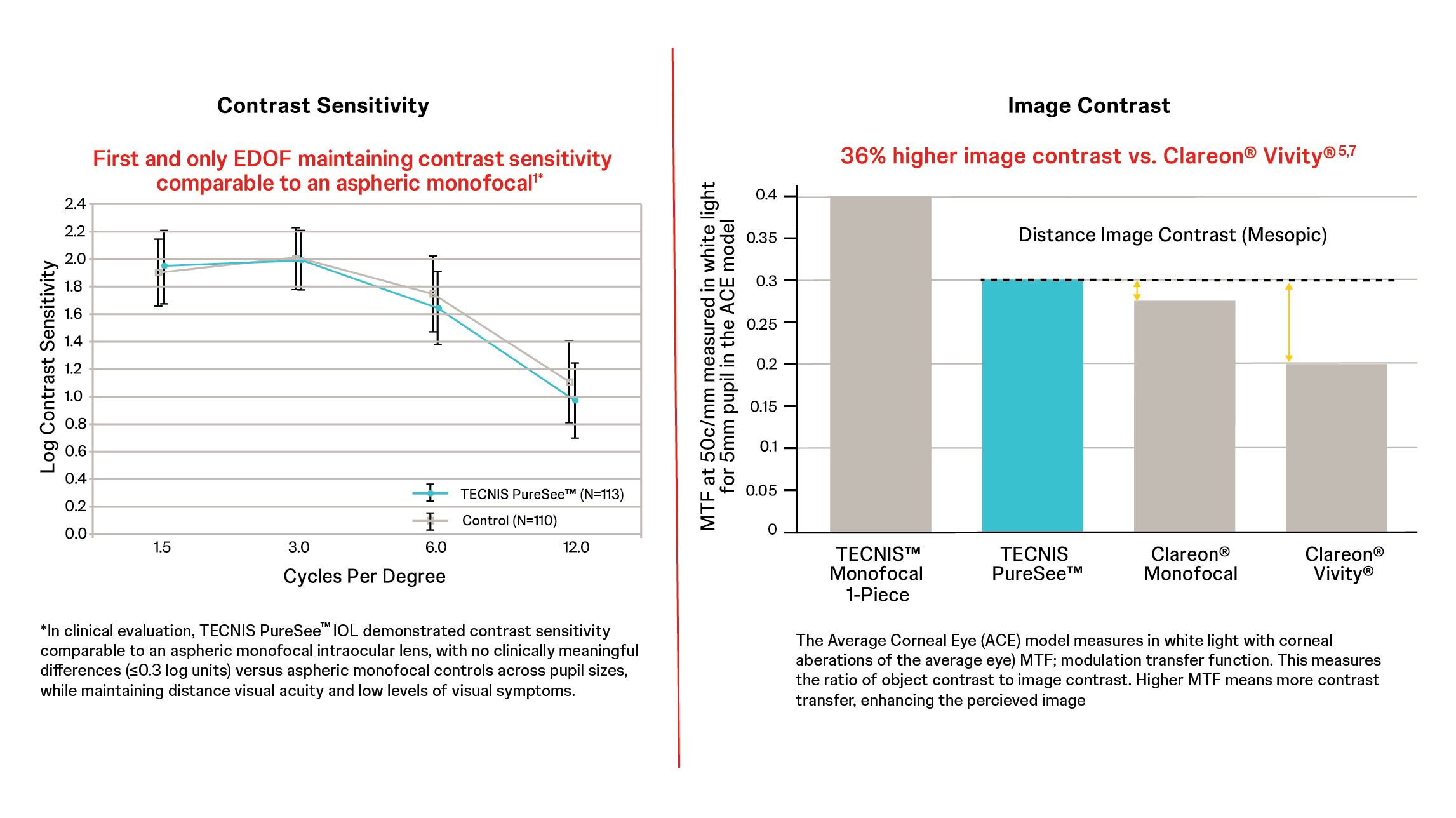
The first & only EDOF IOL in the U.S. without a warning on loss of contrast sensitivity*1,4

Excellent Image Contrast

The purely refractive design enables a monofocal-like dyphotopsia1

Even under defocus, leading to high patient satisfaction3

TECNIS[^TM] Monofocal 1-Piece IOL

TECNISTM Monofocal 1-Piece IOL

TECNIS PureSee[^TM] IOL

TECNIS PureSeeTM IOL

optical bench testing: DOF2023CT4012

Tolerance to Refractive Error Providing Pure Ease of Mind3

TECNIS[^TM] Monofocal 1-Piece IOL and TECNIS PureSee[^TM]

Cataract Vision Simulator

Check out our Vision Simulator to better understand the visual benefits of our different IOL options.

No lens dining

Learn More

Get the latest news and product info from Johnson & Johnson.
Required fields are marked with an asterisk
*
*
*
*
*
Area of Interest
*
Cataract Surgery
OS Disease
LASIK Surgery
Send me updates and helpful resources via email
*

With your consent, we will use your information to send you information about our products and services tailored to your interests through email. You may withdraw your consent at any time.

Please read our Privacy Policy.

This site is protected by reCAPTCHA and the Google Privacy Policy and Terms of Service apply.

1. TECNIS PureSee IOL, Model DEN00V, DFU US, Z312075E rev B.

2. DOF2023CT4043_Clinical Investigation of the TECNIS Intraocular Lens, Models CV1000 and CV2000. Patient satisfaction outcomes. Prospective, randomized, multi-center 6-month clinical study. N=66

3. Black DA, et al. Tolerance to refractive error with a new extended depth of focus intraocular lens. Eye (Lond). 2024;38(Suppl 1):15-20. doi: 10.1038/s41433 -024 - 03040 -1. Erratum in: Eye (Lond). 2025;39(1):203. doi: 10.1038/s41433 -024 -03422 -5.

4. 2024REF4215 Clareon® Vivity® Directions for Use.

5. DOF2018OTH4004 TECNIS Enhance and competitors simulated MTF.

6. 2024REF4933 Alarcon, Aixa, et al. Optical and clinical simulated performance of a new refractive extended depth of focus intraocular lens. Eye 38.Suppl 1 (2024): 4-8.

7. DOF2023CT4025.


INDICATIONS and IMPORTANT SAFETY INFORMATION for TECNIS PureSee IOL and TECNIS PureSee Toric II IOLs with TECNIS SIMPLICITY Delivery System

Rx Only

INDICATIONS FOR USE:

The TECNIS SIMPLICITY Delivery System is used to fold and assist in inserting the TECNIS PureSee IOL, which is indicated for primary implantation for the visual correction of aphakia in adult patients with less than 1 diopter of pre-existing corneal astigmatism in whom a cataractous lens has been removed. The lens mitigates the effects of presbyopia by providing an extended depth of focus. Compared to an aspheric monofocal IOL, the TECNIS PureSee IOL provides improved intermediate visual acuity, while maintaining comparable distance visual acuity. The lens is intended for capsular bag placement only.


The TECNIS SIMPLICITY Delivery System is used to fold and assist in inserting the TECNIS PureSee Toric II IOLs, which are indicated for primary implantation for the visual correction of aphakia and for reduction of refractive astigmatism in adult patients with greater than or equal to 1 diopter of preoperative corneal astigmatism in whom a cataractous lens has been removed. The lenses mitigate the effects of presbyopia by providing an extended depth of focus. Compared to an aspheric monofocal IOL, the TECNIS PureSee Toric II IOLs provide improved intermediate visual acuity, while maintaining comparable distance visual acuity. The lenses are intended for capsular bag placement only.


WARNINGS:

  1. Physicians should weigh the potential benefit/risk ratio of IOL implantation in patients with any of the conditions listed below, as intraocular lenses may exacerbate an existing condition or may pose an unreasonable risk to the eyesight of patients. The following conditions are not specific to the design of the IOL and are attributed to cataract surgery and/or IOL implantation in general:
    1. Recurrent severe anterior or posterior segment inflammation of unknown etiology
    2. Posterior segment diseases of which monitoring or treatment ability may be limited by an intraocular lens
    3. Surgical difficulties at the time of cataract extraction and/or intraocular lens implantation that might increase the potential for complications (e.g., persistent bleeding, significant iris damage, uncontrolled positive pressure, or significant vitreous prolapse or loss)
    4. Compromised posterior capsule or zonules due to previous trauma or developmental defect in which appropriate support of the IOL is not possible
    5. Risk of damage to the endothelium during implantation
    6. Suspected microbial infection
    7. Congenital bilateral cataracts
    8. Previous history of, or a predisposition to, retinal detachment
    9. Potentially good vision in only one eye
    10. Medically uncontrollable glaucoma
    11. Corneal endothelial dystrophy
    12. Proliferative diabetic retinopathy
  2. Rotation of the toric lens away from its intended axis can reduce its astigmatic correction. Misalignment greater than 30° may increase postoperative refractive cylinder. If necessary, lens repositioning should occur as early as possible prior to lens encapsulation.
  3. Do not attempt to disassemble, modify or alter the delivery system or any of its components, as this can significantly affect the function and/or structural integrity of the design.
  4. Do not use if the cartridge of the delivery system is cracked or split prior to implantation.
  5. Do not implant the lens if the rod tip does not advance the lens or if it is jammed in the delivery system.
  6. Do not stop, reverse or advance the plunger too slowly (for example more than 1 second) during initial lens advancement. Doing so may result in improper folding of the lens.
  7. Do not advance the lens from the Holding Position prior to fully hydrating the system. A minimum of 1 minute at the Holding Position is required to fully hydrate the system to prevent sticking and a potential scratch or crack to the lens.
  8. Do not advance the lens from the Holding Position until ready for implantation. Interruptions during delivery may result in the lens being scratched or cracked or stuck in the cartridge. Discard the device if the lens has been advanced past the Holding Position but not delivered within 60 seconds.
  9. The lens and delivery system should be discarded if the lens has been folded within the cartridge for more than 10 minutes. Not doing so may result in the lens being stuck in the cartridge.
  10. Johnson & Johnson Surgical Vision, Inc., single-use medical devices are labeled with instructions for use and handling to minimize exposure to conditions which may compromise the product, patient, or the user. When used according to the directions for use, the delivery system minimizes the risk of infection and/or inflammation associated with contamination.
  11. The reuse/resterilization/reprocessing of Johnson & Johnson Surgical Vision, Inc. single-use medical devices may result in physical damage to the medical device, failure of the medical device to perform as intended, and patient illness or injury due to infection, inflammation, and/or illness due to product contamination, transmission of infection, and lack of product sterility.


PRECAUTIONS:

  1. Prior to surgery, the surgeon must inform prospective patients of the possible risks and benefits associated with the use of this device and provide a copy of the patient information brochure to the patient.
  2. Autorefractors may not provide optimal postoperative refraction of patients with the IOL. Manual refraction with maximum plus technique is strongly recommended.
  3. This is a single-use device. Do not resterilize the lens or the delivery system. Most sterilizers are not equipped to sterilize the soft acrylic material of the IOL and the preloaded inserter material without producing undesirable side effects.
  4. Do not store the device in direct sunlight or at a temperature under 41°F (5°C) or over 95°F (35°C).
  5. Do not autoclave the delivery system.
  6. The contents are sterile unless the package is opened or damaged.
  7. Do not use if the delivery system has been dropped or if any part was inadvertently struck while outside the shipping box. The sterility of the delivery system and/or the lens may have been compromised.
  8. The recommended temperature for implanting the lens is at least 63°F (17°C).
  9. Do not advance the lens unless ready for lens implantation.
  10. Do not leave the lens in a folded position more than 10 minutes.
  11. When the delivery system is used improperly, the lens may not be delivered properly (i.e., haptics may be broken). Please refer to the specific Directions For Use section provided.
  12. The use of balanced salt solution or ophthalmic viscosurgical devices (OVDs) is required when using the delivery system. For optimal performance when using OVD, use the HEALON family of OVDs. The use of balanced salt solution with additives has not been studied for this product.
  13. The lens should be placed entirely in the capsular bag. The lens should not be placed in the ciliary sulcus.
  14. Carefully remove all viscoelastic and do not over-inflate the capsular bag at the end of the case. Residual viscoelastic and/or over-inflation of the capsular bag may allow the lens to rotate, causing misalignment of the toric lens with the intended axis of placement.
  15. Do not reuse.
  16. Recent contact lens usage may affect the patient’s refraction; therefore, in contact lens wearers, surgeons should establish corneal stability without contact lenses prior to determining IOL power.
  17. The IOL is designed for optimum visual performance when emmetropia is targeted.
  18. The TECNIS Toric IOL Calculator includes a feature that accounts for posterior corneal astigmatism (PCA). The PCA is based on an algorithm that combines published literature (Koch, et al., 2012) and a retrospective analysis of data from a TECNIS Toric multi-center clinical study. The PCA algorithm for the selection of appropriate cylinder power and axis of implantation was not assessed in the prospective TECNIS Toric IOL U.S. IDE study and may yield results different from those in the TECNIS PureSee Toric II IOL labeling. Please refer to the TECNIS Toric IOL Calculator user manual for more information.
  19. The use of methods other than the TECNIS Toric IOL Calculator to select cylinder power and appropriate axis of implantation were not assessed in the TECNIS Toric IOL U.S. IDE study and may not yield similar results. Accurate keratometry and biometry, in addition to the use of the TECNIS Toric IOL Calculator (www.TecnisToricCalc.com) are recommended to achieve optimal visual outcomes for the TECNIS PureSee Toric II IOLs.
  20. All preoperative surgical parameters are important when choosing a toric lens for implantation, including preoperative keratometric cylinder (magnitude and axis), incision location, the surgeon’s estimated surgically induced astigmatism (SIA) and biometry. Variability in any of the preoperative measurements can influence patient outcomes and the effectiveness of treating eyes with lower amounts of preoperative corneal astigmatism. The effectiveness of the toric lens in reducing postoperative residual astigmatism in patients with preoperative corneal astigmatism less than 1.0 diopter has not been demonstrated.
  21. All corneal incisions were placed temporally in the TECNIS Toric IOL U.S. IDE study. If the surgeon chooses to place the incision at a different location, outcomes may be different from those obtained for the TECNIS Toric IOL. Note that the TECNIS Toric IOL Calculator incorporates the surgeon’s estimated SIA and incision location when providing IOL options.
  22. Children under the age of 2 years are not suitable candidates for intraocular lenses.
  23. The safety and effectiveness of the TECNIS PureSee IOLs have not been substantiated in pregnant women, patients under the age of 22 or those with preexisting ocular conditions and intraoperative complications, including those specified in the Warnings and Precautions. Careful preoperative evaluation and sound clinical judgment should be used by the surgeon to decide the benefit/risk ratio before implanting a lens in a patient with one or more of these conditions.


Before Surgery

  • Pupil abnormalities
  • Prior corneal refractive or intraocular surgery
  • Choroidal hemorrhage
  • Chronic severe uveitis
  • Concomitant severe eye disease
  • Extremely shallow anterior chamber
  • Medically uncontrolled glaucoma
  • Microphthalmos
  • Non-age-related cataract
  • Proliferative diabetic retinopathy (severe)
  • Severe corneal dystrophy
  • Severe optic nerve atrophy
  • Irregular corneal astigmatism
  • Amblyopia
  • Macular disease


During Surgery

  • Excessive vitreous loss
  • Non-circular capsulotomy/capsulorhexis
  • The presence of radial tears known or suspected at the time of surgery
  • Situations in which the integrity of the circular capsulotomy/ capsulorhexis cannot be confirmed by direct visualization
  • Cataract extraction by techniques other than phacoemulsification or liquefaction
  • Capsular rupture
  • Significant anterior chamber hyphema
  • Uncontrollable positive intraocular pressure
  • Zonular damage

24. Potential complications generally associated with cataract surgery include, but are not limited to: endophthalmitis/intraocular infection, hypopyon, hyphema, IOL dislocation, persistent cystoid macular edema, pupillary block, retinal detachment/tear, persistent corneal stromal edema, persistent uveitis, persistent raised intraocular pressure (IOP) requiring treatment (e.g., AC tap), retained lens material, or toxic anterior segment syndrome, or any other adverse event that leads to permanent visual impairment or requires surgical or medical intervention to prevent permanent visual impairment.


ATTENTION

Reference the Directions for Use for a complete listing of Indications and Important Safety Information.

2026PP05128
Johnson & Johnson MedTech
We support the AdvaMed Code of Ethics on interacting with Healthcare Professionals.
Advamed Logo
© Johnson & Johnson and its affiliates 2024. All rights reserved. This site is published by Johnson & Johnson Vision Care, Inc. and Johnson & Johnson Surgical Vision, Inc., which are solely responsible for its content.

This product information is intended for use by customers and healthcare professionals in the United States only. We recognize that the Internet is a global communications medium; however, laws, regulatory requirements, and product information for medical products can vary from country to country. The product information included here may not be appropriate for use outside the United States, and the information from other sites you visit may not be appropriate for use in the United States.

Third party trademarks used herein are trademarks of their respective owners.

Vision Made Possible
PP2023OTH5699 v3